What Is Page Authority? (Meaning, Score & Importance)
What is page authority? It is a score from 1 to 100 that predicts how well a single web page can rank on search engine results pages. Moz created the metric, and SEOs use it to compare one page against another. The higher the score, the stronger the page’s link profile and the better its chance to rank.
If you have seen “PA” in a toolbar or an SEO report and wondered what it really tells you, this guide is for you. I’ll explain the meaning in simple words, show how the score is calculated, what a good score looks like, how it differs from domain authority, and how to raise it without risky shortcuts.
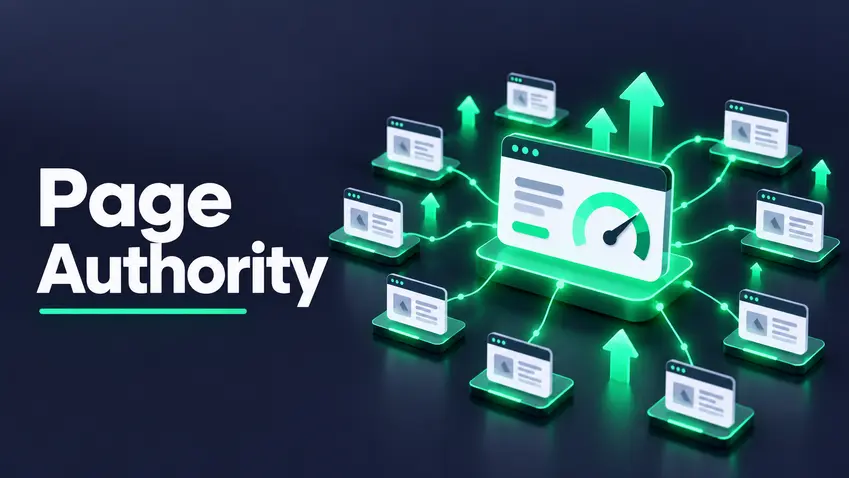
What Is Page Authority in SEO and What Does It Mean?
Quick answer: Page authority (PA) is a Moz score from 1 to 100 that predicts how likely a single web page is to rank in search results. A higher PA means the page has a stronger link profile. It is a third-party metric, not a Google ranking factor, and SEOs mainly use it to compare pages.
Let’s start with a clear page authority definition. It is a ranking-strength score developed by Moz. It looks at one specific URL, like a blog post or a service page, and estimates how strong that page is compared with other pages on the web. Put simply, the website page authority definition SEO professionals use is: a prediction of how well one page can rank, based mostly on its links.
What does page authority mean in real life? Think of it as a report card for links. A page that many trusted websites link to earns a better grade. A brand-new page with no links starts near the bottom. That is the page authority meaning in one line: a relative strength score, not a promise of rankings.
Moz PA Explained in Plain English
Here is Moz page authority explained without jargon. Moz crawls the web and builds a huge link index. A machine learning model then studies thousands of search results and finds the calculation that best matches the rankings it sees. That calculation is applied to every page in the index, and the result is the score you see.
So, what is Moz page authority in practice? It’s a number between 1 and 100 for any URL in Moz’s index. People also ask what is page authority rank from Moz. It isn’t a rank or position; it’s a score. A page with PA 40 simply looks stronger than a page with PA 25, and the score can move when Moz updates its index.
What Is Page Authority Example? A Simple Illustration
Imagine two articles about “best running shoes for flat feet.” Article A has a PA of 45 and links from 30 different websites. Article B has a PA of 12 and links from three. If everything else is equal, Article A has the better chance of ranking higher.
But “everything else” is never equal. Article B might answer the question better or come from a more trusted brand. That’s why PA is a guide, not a guarantee. (Illustrative numbers, not real data.)
What Is PA and DA in SEO?
PA stands for Page Authority and DA stands for Domain Authority. Both are Moz metrics on the same 1 to 100 scale. PA scores a single page, while DA scores a whole domain or subdomain. So if you’ve been wondering what is DA PA, that’s the short answer.
PA in SEO is the page-level number, and DA is the site-level number.
How Is Page Authority Determined?
Quick answer: Moz calculates PA with a machine learning model built mostly on link data. It looks at the number of linking root domains, the quality of those links, anchor text, spam signals and more than 40 factors in total. It does not measure keywords or content quality directly.
Now, what determines page authority Moz reports? And how is page authority calculated? Moz doesn’t publish the exact formula, but it says the model is link-centric and uses dozens of factors. The main signals it lists are:
- Linking URLs, linking root domains and linking subdomains
- MozRank and MozTrust (link popularity and trust)
- Followed and nofollowed links
- Anchor text distribution
- 301 and 302 redirect status, and new versus old links
- Top-level domains, domain names and branded mentions
- Spam Score
Almost everything on that list is about who links to the page, and how.
What Contributes to Page Authority the Most?
If you wonder what drives the score, three things stand out:
- Link diversity. Ten links from ten relevant websites usually help more than ten links from one site.
- Link quality. A link from a trusted, relevant page carries more weight than one from a thin or spammy page.
- Spam signals. An unnatural link profile can pull the score down.
What PA Does Not Measure
This is where many guides go wrong. Some say the score depends on title tags, keywords or content quality. According to Moz, PA does not consider on-page elements like keyword use. Page speed, design and social shares aren’t in Moz’s own list either. Good content helps you earn links, and links raise PA, so the effect is indirect.
One more thing: PA runs on a logarithmic scale. Moving a page from 20 to 30 is much easier than moving it from 70 to 80. Moz also updates its model regularly, so scores fluctuate. Use PA to compare pages over time, not as a fixed grade.
What Is a Good Page Authority Score?
Quick answer: There is no official good score, because PA is relative. As a rough guide, 30 to 50 is decent, 50 to 70 is strong, and above 70 is excellent. The best benchmark is the PA of the pages already ranking in the top three for your keyword.
Moz itself says PA works best as a comparative metric. Still, people need a rough guide, so here is my own rule of thumb (not an official Moz scale).
| PA range | What it usually means |
|---|---|
| 1 to 20 | New or lightly linked page. Normal for fresh content. |
| 21 to 30 | Emerging. Can rank for low-competition keywords. |
| 31 to 50 | Good. Competitive for most niche and local keywords. |
| 51 to 70 | Strong. Solid link profile for tougher search results. |
| 71 and above | Excellent. Usually major publishers and well-known resources. |
What Is a Good Moz Page Authority for Your Keyword?
So, what is a good Moz page authority? The one that matches or beats the pages already ranking for your keyword. A PA of 25 can be enough for a local, low-competition search, but far too low for a finance query. In other words, what is a good page authority depends on the results you’re competing against.
What is good page authority for your own page, then? Look at the top three results. That range becomes your target. Here is how to benchmark it in four steps:
Search your target keyword on Google.
Switch on MozBar (or use Link Explorer) and note the PA of the top three results.
Check your own PA and your number of linking root domains.
Calculate the gap, then study who links to those top pages.
Example: your PA is 28 and the top three average 48. Your next step isn’t “raise PA by 20.” It’s “find who links to those pages and earn similar links.” Remember, a low PA can still rank when the page matches search intent better.
Page Authority vs Domain Authority
Quick answer: PA measures the ranking strength of one page. Domain authority measures the strength of a whole domain. Both come from Moz, use the same 1 to 100 scale and rely on the same link-based method. The main difference is scope: one URL versus an entire website.
Searching for domain authority vs page authority? Many people mix them up, so here is a simple comparison.
| Feature | PA | DA |
|---|---|---|
| Measures | Ranking strength of one page | Ranking strength of a whole domain |
| Created by | Moz | Moz |
| Scale | 1 to 100, logarithmic | 1 to 100, logarithmic |
| Best used for | Comparing specific URLs | Comparing websites |
| Google ranking factor? | No | No |
This is also the answer to what is page authority and domain authority when you use them together: DA is the strength of the website, and PA is the strength of one URL. They aren’t rivals; they answer different questions.
What Is the Difference Between Domain Authority and Page Authority?
In practice, the difference is scope. A large news website has a high DA, yet a brand-new article on it still has a low PA until it earns links. On the other hand, a small blog with a low DA can have one article with a surprisingly high PA because several good websites link to it.
Is Domain or Page Authority More Important?
Neither, really. Use PA to judge a single URL, like a competitor’s article or a link target. Use DA to judge a whole website. For link building, check both. A link from a strong page on a relevant, high-DA website is usually the best of both worlds.
PA vs Google PageRank
Don’t confuse PA with PageRank. PageRank is Google’s own link-analysis system, and Google stopped showing public PageRank scores in 2016. Moz’s metric is a separate, third-party estimate. The names sound alike, but they are different things.
Why Page Authority Is Important
Quick answer: PA is important because it helps you compare pages, choose better link targets and track link-building progress. It won't change your rankings by itself. Think of it as a diagnostic tool that shows where your page stands against competitors, so you can decide where to invest your effort.
So, what is page authority and why is it important? It gives you a quick, comparable number for a page’s link strength. Here are four ways to use it:
- Competitor research. See how strong your page needs to become.
- Link prospecting. If one site offers a link from a page with PA 49 and another from a page with PA 91, you'd usually choose the second.
- Internal linking. Knowing your strongest pages tells you where to link from when you publish something new.
- Reporting. Show month-over-month growth after link building, and spot sudden drops, for example after lost links.
Why domain authority and page authority are important together is simple. DA tells you whether a website is worth working with, and PA tells you whether a specific page is. But PA isn’t a Google ranking factor, and setting it as a KPI tempts teams to chase low-quality links. Use it as a diagnostic, not a scoreboard.
How to Increase Page Authority (Without Shortcuts)
Quick answer: To grow your PA, earn links from relevant, trusted websites, because PA is mostly link-based. Then support those links with strong internal linking, updated content, clean technical health and a topic cluster. Avoid paid links and link schemes, which can lead to penalties.
Moz says this score is holistic and hard to influence directly. So how to increase page authority Moz’s way? Improve the link profile. Everything else supports that. Here’s how to improve page authority step by step.
1. Earn Relevant Backlinks (How to Build Page Authority)
If you want to build authority, start with links. Earn them from relevant, trusted pages. Original research, free tools, useful guides and guest posts on relevant sites all work. Use Moz Link Explorer to see who links to competitors, then plan outreach. Don’t buy links.
2. How to Boost Page Authority With Internal Links
To boost the authority you’ve already earned, link from your strongest pages to the ones you want to lift. Use clear, descriptive anchor text. Internal links don’t create new authority, but they spread what you have across your site.
3. Update Content to Improve Authority
Upgrade an existing URL with fresh data, clearer answers and better visuals. A better page earns more links, and updated pages often get cited again.
4. How to Raise Page Authority by Fixing Technical Problems
Make sure the link value you earn isn’t wasted. Fix broken links and redirect chains, keep the page indexable, and check Core Web Vitals. These fixes don’t change Moz’s formula, but they stop good pages from being held back.
5. Build a Topic Cluster
Pages rarely rank alone. Support your page with related articles that link back to it. This helps readers, and it gives other writers more reasons to cite you.
To check PA, paste your URL into Moz Link Explorer or switch on MozBar, and track the score monthly.
3 PA Myths to Ignore
- Myth 1: A high PA guarantees top rankings. It doesn't. Search intent, content quality and competition still matter.
- Myth 2: PA is a Google metric. It's a Moz metric. Google doesn't use or publish it.
- Myth 3: Keywords and title tags raise PA directly. Moz says they don't. Good on-page SEO helps only by earning more links over time.
Frequently Asked Questions (FAQs)
No. Google doesn't use Moz's PA in its rankings and doesn't acknowledge it as a ranking factor. PA is a third-party metric. Google does use links as a signal, which is why PA often correlates with rankings. Treat it as a useful proxy, not a cause.
Yes, but as a diagnostic, not a goal. PA still helps you compare pages, pick link targets and track link-building progress. It doesn't guarantee rankings, and a page with a lower PA can outrank one with a higher PA if it matches search intent better.
There is no official good score, because PA is relative. As a rough guide, 30 to 50 is decent and 50 to 70 is strong for most niches. The best target is the PA range of the pages already ranking in the top three for your keyword.
Paste your page URL into Moz Link Explorer, or switch on the MozBar toolbar to see PA beside any search result. Check monthly rather than daily, because scores fluctuate as Moz updates its index.
PA means Page Authority and DA means Domain Authority. Both are Moz scores from 1 to 100 that predict ranking strength. PA scores a single page, while DA scores an entire domain or subdomain. Both rely mainly on link data.
Final Thoughts
PA is a useful compass, not a finish line. Benchmark it against the pages you want to beat, and spend your energy on earning relevant links.
About the author: Yadav Sintu is the founder of TechMarg (techmarg.in), a technical SEO and digital marketing agency serving Patna, Delhi NCR and Dehradun. He works on technical SEO, local SEO, Google Business Profile optimization, Core Web Vitals and content strategy.