
Domain Authority vs Domain Rating: Which Metric Actually Matters for SEO?
- June 30, 2026
If you’ve ever checked the same website on Moz and on Ahrefs and gotten two completely different scores, you’re not imagining it. Domain Authority (DA) and Domain Rating (DR) are not the same metric, they are not calculated the same way, and — according to Google’s own Search Advocate, John Mueller — neither one is used by Google to rank a single page.
Most beginners treat DA and DR as interchangeable, assume a bigger number always means a “better” site, and panic when their score drops overnight. None of that is quite right, and this guide untangles exactly why.
In this guide, you’ll learn what Moz Domain Authority and Ahrefs Domain Rating actually measure, how each one is calculated, whether a high DR is genuinely “better” than a high DA, and what causes these scores to drop without warning. Every figure and quote below is linked to its original source — Moz, Ahrefs, Google, or a peerreviewed study — so you can verify it yourself.
Before comparing Domain Authority and Domain Rating, it’s important to understand what Domain Authority is and how it works.
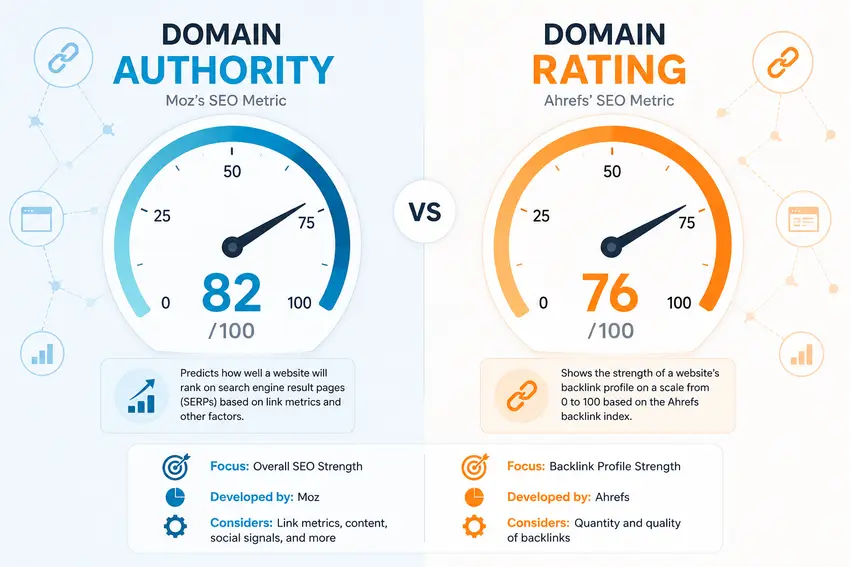
Is Domain Rating the Same as Domain Authority?
No. Domain Authority and Domain Rating are built by two competing companies, using two different web indexes, two different formulas, and two different goals. They share a 0–100 scale and the word “authority,” and that surface-level similarity is the entire reason people confuse them.
Quick Answer
Domain Authority (DA) is Moz’s score that predicts how likely a site is to rank in Google. Domain Rating (DR) is Ahrefs’ score that measures only the strength of a site’s backlink profile. Both run on a logarithmic 0–100 scale, but different inputs mean the same website can — and often does — get two different numbers from each tool
What is Moz Domain Authority (DA)?
Domain Authority is a 1–100 score, developed by Moz, that predicts how likely a website is to rank in search engine results pages. Moz introduced the concept around 2009 and rebuilt the scoring system in its “Domain Authority 2.0” update in early 2019, which replaced the older formula with a machine-learning model trained to correlate link data with real Google rankings.
DA is calculated using Moz’s own Link Explorer backlink index, run through that machine-learning model. Moz has confirmed the metric relies heavily on backlink data — the number and quality of linking root domains is a major input — but the company has not published a complete, exact list of every signal in the model
What is Ahrefs Domain Rating (DR)?
Domain Rating is Ahrefs’ own 0–100 score for the strength of a website’s backlink profile specifically. Ahrefs is far more transparent about the formula than Moz is: DR is calculated by looking at how many unique referring domains link to a site, the DR of each of those linking domains, and how many other sites those domains link out to (which dilutes the value passed on).
Ahrefs states plainly that Domain Rating does not factor in link spam, site traffic, or domain age — it is a backlink-only metric, full stop.
Why Do People Confuse DR and DA?
A few reasons line up at once: both run on a 0–100 logarithmic scale, both use the word “authority” or get described that way, both started as link-based scores, and neither is a Google ranking factor — so SEOs lump them together as shorthand for “site strength” even though the underlying math is unrelated.
Industry survey data backs up just how blended the two have become in everyday use. In Aira’s 2022 “State of Link Building Report,” 67% of surveyed SEO professionals said they favored Ahrefs’ DR as their go-to authority metric, versus 42% who favored Moz’s DA — meaning a large share of SEOs use both, often for the same decisions, despite the metrics measuring different things.
What is the Difference Between DR and DA?

The core difference is scope. Domain Rating measures one thing — backlink strength — through a transparent, publicly explained linkgraph formula. Domain Authority tries to predict a much broader question — overall ranking likelihood — using a machine-learning model trained on multiple signals, most of which Moz has not fully disclosed.
How DA and DR are Calculated (The Algorithm)
Domain Rating’s formula, per Ahrefs’ own documentation, works like this: only dofollow links count, the diversity of referring domains matters more than raw backlink volume, and a domain’s “vote” gets diluted depending on how many other sites that domain links out to. A single link from a massive site barely moves your DR, because that site’s authority is split across every domain it links to.
Domain Authority’s formula is harder to pin down precisely because Moz doesn’t publish a step-by-step breakdown. What’s confirmed: it’s primarily backlink-driven, it runs through a machine learning model benchmarked against real SERPs, and Moz has acknowledged the score can be artificially inflated, though apparently with more difficulty than DR.
Here’s where it gets genuinely interesting: even Ahrefs’ own largescale 2025 research found that DR’s correlation with actual SERP rankings — across one million keywords — was only 0.131, which Ahrefs itself describes as “a small positive correlation, and far from definitive.” That’s a notably more cautious finding than Backlinko’s widely cited 2023 study (run with Ahrefs as data partner), which concluded that a site’s overall link authority, as measured by Domain Rating, “strongly correlates” with higher rankings, and that the #1 Google result averages 3.8x more backlinks than positions #2–10. Both studies are legitimate; the difference shows how much correlation strength depends on methodology — and it’s a good reminder not to treat any single backlink metric as gospel.
Database Size and Update Frequency
This is where third-party reporting gets genuinely inconsistent, so treat the specific numbers as directional rather than fixed. Independent comparison sites in 2025–2026 have reported that Moz’s link index is, by raw size, sometimes larger than Ahrefs’ (one comparison cited 44.8 trillion indexed links for Moz versus 35 trillion for Ahrefs). But size isn’t the whole story: the same and other comparisons consistently report that Ahrefs discovers and reflects new backlinks much faster — often within hours — while Moz’s index has been reported to take roughly 24–72 hours to catch up.
Vendors update these figures constantly and don’t always publish them the same way, so don’t anchor a decision on the exact trillionlink number. The consistent, repeatedly-reported pattern is: Moz’s index tends to be more exhaustive in raw size; Ahrefs’ crawler tends to be faster at surfacing brand-new links
Logarithmic Scale Explained (0 to 100)
Both DA and DR are logarithmic, not linear — and Ahrefs explains exactly why in its own data. The vast majority of domains on the internet are small, new, or abandoned, so they cluster at the bottom of the scale, around DR 0–10. Climbing from DR 20 to 30 takes a handful of new links. Climbing from DR 70 to 80 can take thousands.
The same logarithmic logic applies to Moz’s DA: moving a young site from DA 20 to DA 30 is comparatively easy, while pushing an established site from DA 70 to DA 80 takes a sustained, long-term link-building effort. This is also exactly why a brand-new domain starts at the bottom of both scales and why huge jumps in either score should make you suspicious, not excited.
Is a High DR Better Than a High DA?
Neither is automatically “better” — DR and DA measure different things, so a high score on one does not guarantee a high score on the other. A real website can have a strong Domain Rating and a weak Domain Authority at the same time, simply because the two scores are pulled from different indexes using different formulas.
When to Trust Ahrefs DR Over Moz DA
Ahrefs itself recommends using DR as “a good proxy by which to judge the relative quality of link prospects” — but explicitly warns never to judge a website’s quality on site-wide authority alone. DR’s transparent, link-only formula makes it easier to understand why a score moved, which is exactly why it’s the more popular choice specifically for link-building decisions: Aira’s 2022 survey found 82% of SEOs use Ahrefs as their primary tool, likely contributing to DR’s lead as the preferred authority metric.
Because DA folds in more signals beyond pure backlink data, it’s often used as a broader, single-number snapshot for competitive benchmarking across a SERP — comparing many sites at once without digging into each one’s full backlink profile. Moz also offers a Spam Score feature, built specifically to flag toxic or manipulative link patterns, which Ahrefs’ DR-focused toolset doesn’t directly replicate in the same way.
The Danger of Chasing Vanity Metrics
Google has been unusually direct and consistent about this one. In 2019, John Mueller said on social media, “We don’t use domain authority; that’s a metric from an SEO company.” In 2020, he stated that “Google doesn’t use Domain Authority at all when it comes to Search crawling, indexing, or ranking.” In a 2022 Reddit AMA, he went further: “I don’t think I’ve ever looked up the DA for a site in the 14 years I’ve done this.” Google’s Gary Illyes has separately confirmed that Moz’s DA metric isn’t part of Google’s algorithm either.
Both DA and DR can also be artificially inflated. A documented test by SEO research firm Xamsor hired several Fiverr “authority hackers” to boost five new domains’ DR, DA, and Majestic Trust Flow scores simultaneously. After two months, the scores rose — but Moz’s own data showed the test site still had zero ranking keywords. The scores moved; the actual ranking ability did not.
How to Check and Improve Your Website’s Authority Score
Free Tools to Check DA and DR
- Ahrefs Website Authority Checker — a free tool, no account required, that returns a domain’s DR, total backlinks, and referring domains.
- Moz’s free Domain Analysis / Link Explorer tool — checks DA for free with a capped number of lookups per day, plus linking root domains and spam score.
- Browser extensions — MozBar (Moz) and the Ahrefs SEO Toolbar both display these scores directly in Google’s search results as you browse.
Safe Strategies to Increase Your DR and DA
Ahrefs’ own guidance is specific on this point: DR rewards the number of distinct domains linking to you, not your raw backlink count — ten
links from ten different sites move your score more than a hundred links from one site. The practical takeaways, sourced from Ahrefs and corroborated across the wider SEO industry:
- Earn links from new, unique referring domains rather than repeatedly from the same few sites.
- Build genuinely linkable assets — original data, free tools, or definitive guides that other sites want to cite naturally.
- Pursue digital PR and editorial mentions in publications relevant to your niche.
- Avoid manipulative link schemes. Google’s Penguin update (launched in 2012) was built specifically to detect and discount spammy, purchased, or networked links, and manual actions for violating link schemes are difficult to recover from.
- Don’t over-rely on the disavow tool. Mueller has indicated Google has historically not been a fan of the disavow file and that sites that weren’t buying spammy links generally don’t need to use it.
What Causes a Sudden Drop in Authority Metrics?
A drop in DA or DR doesn’t necessarily mean your site got worse. Documented causes include: the platform (Moz or Ahrefs) updating its underlying algorithm or index; your direct competitors gaining highquality backlinks faster than you, which pulls down your relative score even if your own profile didn’t change; losing previously-counted backlinks because pages were removed, links went nofollow, or referring sites went offline; and technical crawl issues that prevent the index from seeing your existing links.
Because both DA and DR are comparative, relative scores — measured against every other site in that company’s index — a score drop is sometimes simply the rest of the internet moving, not a flaw in your own SEO.
Conclusion: Domain Authority vs Domain Rating – Which One Should You Follow?
Domain Authority and Domain Rating were never meant to be interchangeable — they’re built by competing companies, on different indexes, for different purposes, and neither one is a Google ranking factor, a point Google’s own John Mueller and Gary Illyes have confirmed directly and repeatedly. Use DR when you need a fast, transparent read on a specific link’s quality. Use DA when you want a broader, single-number snapshot for comparing many competing sites at once. Ideally, check both, alongside relevance and real organic traffic, rather than leaning on either score alone.
The metric that actually moves rankings isn’t the score itself — it’s the real backlinks, relevant content, and technical SEO sitting underneath it. Chase those, and a healthy DR and DA tend to follow on their own.
Run your own domain through both the free Ahrefs and Moz checkers linked above, and compare what you see — then use the benchmarking method in this guide (versus your competitors, your industry, and your target keywords) to judge whether your score is actually “good” for your situation.