
How to Increase Domain Authority in 2026 (Proven Steps)
- June 13, 2026
If you have ever searched for your website on Moz and found a score of 5 or 8, your first instinct was probably to panic. You wonder — is my website invisible on Google? Is my domain authority score low enough to kill my rankings?
Here is the good news: domain authority is not a Google ranking factor. But that does not mean it does not matter. A strong DA score is one of the clearest signals that your website is earning trust, quality backlinks, and real credibility on the web.
In this guide, you will discover exactly what domain authority is, how it is calculated, what a good DA score looks like, and — most importantly — 8 proven steps, how to increase domain authority the right way in 2026.
Whether you are a business owner trying to outrank competitors or an SEO learner building their first website, this guide will give you a clear, actionable roadmap.

What is Domain Authority?
Quick Answer
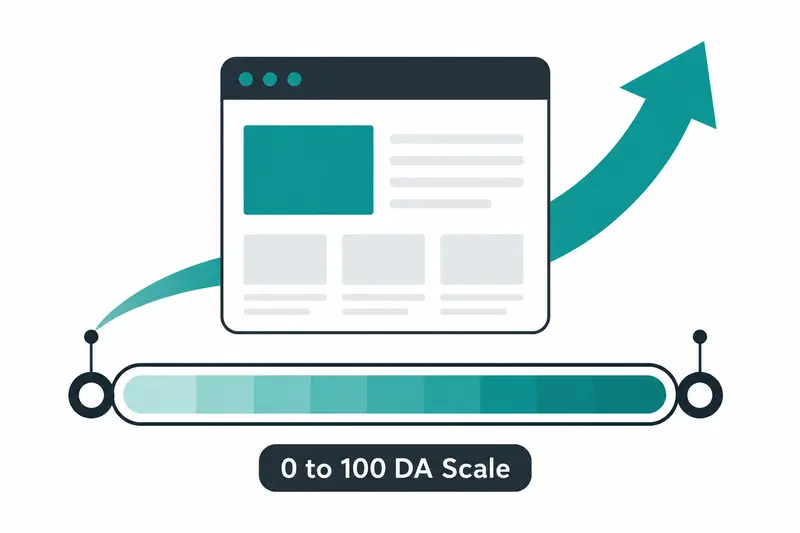
Domain authority (DA) is a score from 0 to 100 developed by Moz that predicts how likely a website is to rank in search engine results. It is calculated based on the number and quality of backlinks pointing to your site. A higher DA score generally means stronger ranking potential. It is a third-party metric — not used directly by Google.
Domain authority was created by Moz to give website owners a single, easy-to-understand number that reflects the overall strength of their backlink profile. The higher the score, the more authoritative your site appears compared to competitors in your niche.
Important: Domain authority is not a metric used or recognized by Google. It is a tool created by Moz to help SEOs compare site strength — nothing more, nothing less.
Think of it like a credit score for your website. Just as a bank uses your credit score to evaluate trustworthiness, SEOs use DA to quickly assess a site’s backlink health and authority compared to others.
Domain Authority vs Authority Score vs Domain Rating — What Is the Difference?
If you have ever used more than one SEO tool, you have probably noticed that each one has its own version of a ‘website authority’ metric. These scores are all measuring a similar concept but use different data and formulas. Understanding the difference between domain authority vs authority score vs domain rating will help you choose the right metric for your work.
| Feature | Domain Authority (DA) | Domain Rating (DR) | Authority Score (AS) |
|---|---|---|---|
| Created by | Moz | Ahrefs | Semrush |
| Scale | 0 – 100 | 0 – 100 | 0 – 100 |
| Metric type | Backlink strength | Backlink strength | Organic traffic + backlinks |
| Used by Google? | No | No | No |
| Best use case | Comparing site authority | Evaluating link sources | Overall site health check |
| Free checker? | MozBar (free) | Website Authority Checker | Semrush free trial |
The core takeaway here is simple: all three metrics measure the strength of your backlink profile. None of them are used by Google. But they are extremely useful for benchmarking your site against competitors and identifying link building opportunities.
When comparing domain rating vs domain authority — DR from Ahrefs tends to update more frequently and is widely considered one of the most accurate backlink-based metrics. DA from Moz is the oldest and most universally recognized.
How is Domain Authority Calculated?
Understanding how domain authority is calculated helps you focus on the right actions to improve your score — instead of wasting time on tactics that do not move the needle.
Moz calculates DA using a machine learning algorithm that analyses multiple factors from its Link Explorer database. The three main factors are:
1. Number of Linking Root Domains
The more unique websites that link to your domain, the better. One link from 500 different websites is far more valuable than 500 links from a single site. Moz calls this ‘linking root domains’ — and it is the single biggest driver of your DA score.
2. Quality of Those Backlinks
Not all backlinks are equal. A single link from a high-DA website like Forbes or Search Engine Journal carries far more weight than 100 links from low-quality directories or spam sites. Google — and DA — both reward quality over quantity.
3. The Logarithmic Scale
Domain authority uses a logarithmic scale, meaning it becomes progressively harder to increase your score as it gets higher. Going from DA 10 to DA 20 is relatively easy. Going from DA 60 to DA 70 can take years. This is why consistency matters more than short-term bursts of link building.
Pro Tip
Nofollow links, sponsored links, and UGC-tagged links do not count toward your DA score. Only followed (dofollow) backlinks from unique domains move the needle. Focus your link building efforts on earning dofollow links from relevant, high-authority websites in your niche.
What is a Good Domain Authority Score?
One of the most common questions from beginners is — what is a good domain authority score? The honest answer is: it depends on your niche and your competitors.
A DA of 30 might be excellent for a local business in a small niche. But the same score would be considered weak for a major news publication competing with sites that have DA 80+.
Here is a simple breakdown of what different DA score ranges mean:
| DA Score | What It Means | Typical Site Profile |
|---|---|---|
| 0 – 10 | Very low | Brand new website, just launched |
| 11 – 30 | Low — building phase | New blogs, local business sites |
| 31 – 50 | Moderate — competitive | Established niche sites, small agencies |
| 51 – 70 | High — strong authority | Industry blogs, established brands |
| 71 – 100 | Very high — elite | Wikipedia, Moz, Ahrefs, Forbes |
The golden rule: always compare your DA to your direct competitors, not to global giants like Wikipedia or BBC. If you are outranking sites with a DA of 35 while sitting at DA 28, your score is working for you.
Does Google Use Domain Authority for Ranking?
Quick Answer
No. Google does not use Moz's Domain Authority metric in its ranking algorithm. DA is a third-party score created by Moz — Google has its own internal systems for evaluating site authority. However, the backlinks that improve your DA are the same signals Google uses to determine trustworthiness and ranking power.
This is one of the most important things to understand: chasing a high DA number for its own sake is a mistake. What matters is the quality backlinks and topical authority that cause your DA to rise naturally.
Google uses its own PageRank algorithm and hundreds of other signals to determine rankings. But quality backlinks — the same thing that boosts your DA — are confirmed top-three Google ranking factors. So while DA itself is not a Google metric, the work you do to increase it directly benefits your Google rankings.
How to Increase Domain Authority — 8 Proven Steps
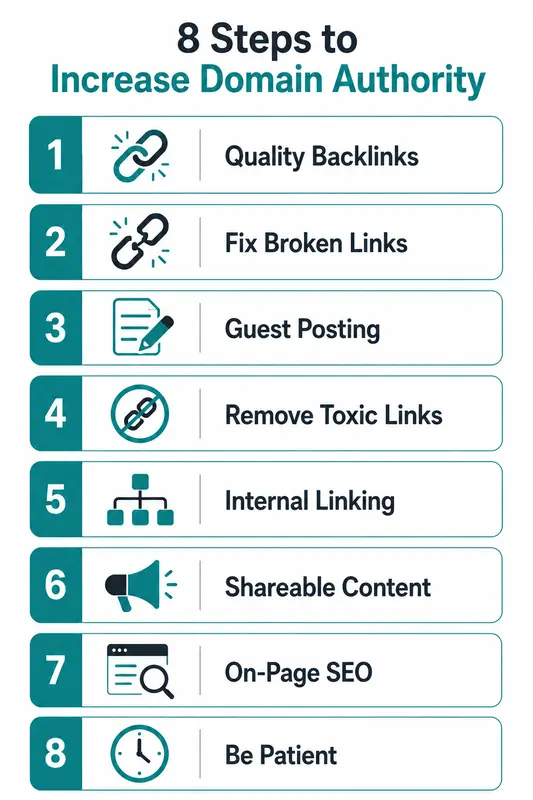
Improving your domain authority is not a one-week task. It requires a consistent, long-term strategy focused on quality over shortcuts. Here are 8 proven steps to boost domain authority the right way:
Step 1: Earn High-Quality Backlinks from Relevant Websites
The single most effective way to increase domain authority is to earn dofollow backlinks from websites that are both high-authority and relevant to your niche. One link from a respected SEO blog is worth more than 50 links from irrelevant directories.
Focus your outreach on websites within your industry. Pitch guest posts, offer to contribute expert quotes, or create content worth linking to naturally.
Step 2: Remove or Disavow Toxic Backlinks
Low-quality or spammy backlinks can actively drag your DA score down. Use the Moz Link Explorer or Semrush Backlink Audit tool to identify toxic links pointing to your site. For links you cannot remove manually, use Google’s Disavow Tool to tell Google to ignore them.
Step 3: Create Link-Worthy Content
The fastest organic path to high-quality backlinks is creating content that people naturally want to reference. This includes original research, detailed how-to guides, comparison articles, and data-driven posts. These content types earn editorial links — the most valuable type.
Step 4: Use Strategic Guest Posting
Guest posting means writing content for other authoritative websites in your niche in exchange for a backlink. Choose websites with a DA higher than yours and a real, engaged audience. Avoid bulk guest post networks — they are flagged as spam and can harm your domain authority.
Step 5: Fix Your Internal Linking Structure
Internal links help Google and other search engines understand your site’s structure and distribute authority (link equity) from your strongest pages to your weaker ones. Every new blog post you publish should link to at least 2–3 relevant existing pages on your site.
Step 6: Build Consistent Brand Mentions
Even unlinked brand mentions contribute to perceived authority. Get your brand name mentioned in industry forums, Quora answers, social media, and press releases. Over time, some of these mentions convert into actual backlinks.
Step 7: Optimise Your On-Page SEO
Strong on-page SEO helps your content rank, which attracts organic backlinks over time. Make sure every page has a clear primary keyword, proper heading structure, descriptive meta tags, and fast loading speed. Core Web Vitals directly influence user experience — which influences how long visitors stay and whether they share your content.
Step 8: Be Patient and Stay Consistent
Domain authority is a long-game metric. Most new websites see meaningful DA improvements between 3 to 6 months of consistent link building. Moving from DA 10 to DA 30 typically takes 6–12 months of steady effort. There are no overnight shortcuts — and any tool or service promising a fast DA boost is almost certainly selling toxic links.
How Long Does It Take to Increase Domain Authority?
This is a question every new website owner asks — and the answer is honest rather than impressive.
- DA 0 to 10: 1 to 3 months — Getting your first few quality backlinks
- DA 10 to 30: 3 to 9 months — Consistent guest posting and directory listings
- DA 30 to 50: 9 to 18 months — Editorial links, strong content, and brand authority
- DA 50+: 18 months+ — Requires sustained authority building and major publications linking to you
The key variable is how aggressively and consistently you pursue quality link building. Two blog posts per week, regular guest posting, and monthly backlink audits will put you well ahead of competitors who do nothing.
Why Did My Domain Authority Drop Suddenly?
A sudden DA drop is one of the most alarming things a website owner can see — especially after months of hard work. Here are the most common reasons it happens:
- Moz algorithm update: Moz periodically recalculates DA across all websites. When they update their index, scores shift up and down — even if you have done nothing wrong.
- Lost backlinks: If a high-DA website that linked to you deleted the article or removed your link, your DA will reflect that loss.
- Competitor growth: DA is a relative metric. If your competitors gained a lot of backlinks while you stood still, your relative score drops even if your absolute backlink count stayed the same.
- Toxic link surge: If you suddenly received a batch of spammy backlinks (sometimes from competitors doing negative SEO), it can lower your DA.
What to Do If Your DA Drops
Run a backlink audit using Moz or Semrush. Identify any recently lost high-DA links and try to reclaim them. Check for new toxic backlinks and disavow if necessary. Keep publishing quality content and earning new links consistently.
Frequently Asked Questions (FAQ)
These are the most commonly searched questions about link building — answered concisely for readers and optimised for AI answer engines and Google’s People Also Ask.
Yes and no. Domain authority is not a metric Google uses directly. However, it is a reliable proxy for backlink quality and overall site authority — both of which are genuine Google ranking signals. A high DA site typically has a strong backlink profile, which does help with rankings. Think of DA as a health indicator, not a ranking guarantee.
A good domain authority score is relative to your niche and competitors. For a new local business or niche blog in India, a DA of 20 to 35 is solid and competitive. For a major industry publication, anything below 50 might feel weak. Always compare your DA to the top 5 competitors ranking for your target keywords — that is your real benchmark.
Domain authority is a 0–100 score created by Moz that measures the predicted ranking strength of a website based on its backlink profile. It is important because it gives you a quick, comparable snapshot of your site's authority relative to competitors. It helps you evaluate backlink opportunities — you generally want links from sites with higher DA than your own.
No. Google does not use Moz's Domain Authority metric in its ranking algorithm. Moz is a private company, and DA is a proprietary metric. Google has confirmed it does not incorporate third-party SEO tool scores into its algorithm. However, the backlinks that cause DA to rise are the same type of links Google rewards — so improving DA indirectly helps your Google rankings.
Domain authority (DA) is a metric by Moz. Domain rating (DR) is a similar metric by Ahrefs. Both measure backlink strength on a 0–100 scale. The key difference is in calculation methodology. Ahrefs' DR updates more frequently and some SEOs consider it more accurate for link prospecting. Moz's DA is older, more widely recognized, and better for quick competitor comparisons. Both are useful — neither is used by Google.
Conclusion
Domain authority is not a magic number that automatically ranks your website — but it is one of the most reliable signals that your site is earning real trust and quality backlinks over time.
To increase your domain authority in 2026, the strategy is clear: earn high-quality backlinks from relevant sites, remove toxic links, create genuinely useful content, and build your site’s authority consistently over months — not days.
If you are just starting out, do not be discouraged by a DA of 5 or 10. Every trusted website you see today started at zero. Focus on the fundamentals, stay consistent, and your score will reflect your effort.
About the Author
Sintu Yadav
Sintu Yadav is the founder of TechMarg, a Technical SEO and digital marketing agency based in Patna, Bihar. He specialises in off-page SEO, Core Web Vitals optimisation, schema markup, and link building strategy. His content has been cited in Google AI Overviews, making him a trusted voice in India's SEO community. He helps businesses across India grow their online authority and organic search presence.